Rudolf Leopold Bought What Others Passed Over
One collector's obsessive argument about taste, and why it still echoes in the rooms he filled
Rudolf Leopold began buying Egon Schiele in the early 1950s, when the painter was barely a name outside a narrow circle of Viennese specialists. The generation that had dismissed Schiele's contorted figures and confrontational nudes as degenerate excess was still alive; the market had not rehabilitated him; and the works — drawings, gouaches, oils — were passing through dealers and estates at prices that reflected the indifference of the moment rather than the gravity of the objects. Leopold, then a young ophthalmologist with a serious eye and a modest income, understood something that the market had not yet worked out. He bought accordingly, and he kept buying for decades.
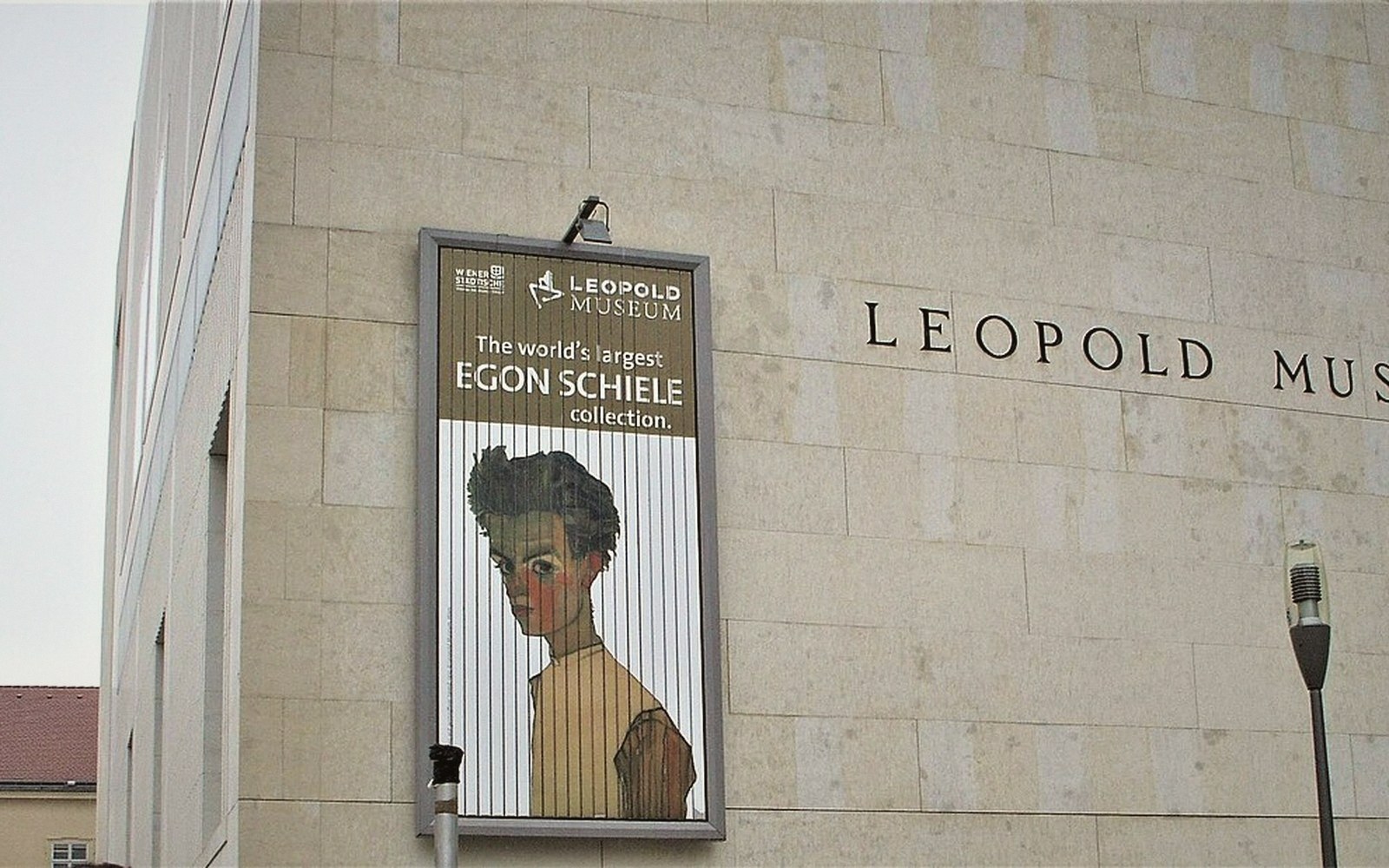
The result is the Leopold Museum in the MuseumsQuartier, opened in 2001, which holds the largest Schiele collection in the world. About forty paintings and a substantial body of works on paper are gathered there — not as the residue of a national institution's long accumulation, but as the record of one man's sustained and occasionally ruthless conviction about what mattered. That is an unusual thing in a city of great museums. The Kunsthistorisches and the Belvedere grew through dynastic inheritance, diplomatic gift, and the coercive mechanisms of imperial power. The Leopold grew because one private collector was right about a painter when almost everyone else was wrong.
How the collection was built
Leopold's method was personal, relentless and financially complicated. He worked through dealers and directly with estates; he traded works he owned for works he wanted more; he took on debt. His purchases were not random exercises in acquisition — they were arguments. He was assembling a particular reading of early-twentieth-century Viennese art, one that placed Schiele at the centre and built outward from there to include Oskar Kokoschka, Richard Gerstl, Albin Egger-Lienz, and a substantial holding of late-nineteenth-century Austrian painting that most international attention had skipped over entirely.
What made Leopold formidable as a collector, and what makes the museum rewarding to walk through slowly, is that he was not merely buying quality — he was making a case for a particular aesthetic lineage. The collection argues, room by room, that the nervous, unresolved energy in Viennese expressionism was not an aberration from the mainstream of European modernism but one of its most consequential episodes. Standing before Schiele's line — angular, unblended, refusing to flatten the body into something comfortable — you are also standing inside Leopold's argument about why that line deserved to survive.
He was not the only person who noticed Schiele's importance, but he was the most systematic about acting on the conviction. By the time the international market caught up, by the late 1960s and into the 1970s, Leopold had already secured the core of what would become the definitive collection. The economic implication was enormous: works acquired at the prices of indifference became, over decades, objects of very substantial value. That shift, from unfashionable to canonical, is also the history of the collection's complications.
The provenance question and what it asks of you
No honest account of the Leopold Collection can avoid what became its most difficult public chapter. Several works in the collection carry provenance histories that pass through the years of National Socialist rule in Austria — the period after the Anschluss of March 1938, when Jewish-owned art collections were dispersed through forced sales, confiscation, and the mechanisms of Aryanisation. The Schiele holdings are large enough that some of the works that entered the art market in those years inevitably found their way, through chains of subsequent sale, into Leopold's hands.
The case that drew the most international attention was that of Wally — the 1912 portrait of Schiele's companion Walburga Neuzil. The painting had belonged to the dealer Lea Bondi Jaray, who was forced to give it up after the Anschluss. It passed through several hands, entered Leopold's collection, was lent to New York's Museum of Modern Art, and was seized by American authorities in 1998 under a legal instrument that had not previously been applied to artworks. The ensuing litigation lasted over a decade and ended in 2010 with a settlement reached between the Leopold Museum Foundation and the heirs of Lea Bondi Jaray. The painting is now in the museum's permanent collection; the settlement terms were not fully disclosed, but it involved a substantial payment to the heirs.
That case was the most visible, but the questions it raised applied more broadly. Austria's 1998 Art Restitution Law opened federal collections to systematic provenance review, and the Leopold Foundation — though technically private — eventually committed to its own review processes. Other claims have been assessed, some resolved, some ongoing. The provenance histories of individual works are not always clear from a gallery label; the museum's published research has been thorough in some areas and criticised as incomplete in others.
This is not information that should make you feel that visiting the Leopold Museum is an act of complicity. It is information that should change how you stand in front of certain works. Provenance is not a bureaucratic footnote — it is part of the object's history, as real as the paint on the surface. The careful visitor reads the label, looks for the dates of ownership, and holds both the visual experience and the historical weight at once. That is not a comfortable position, but it is the honest one, and it is what this collection, more than most in Vienna, demands.
What the rooms give you
Set those complications aside for a moment — not to forget them, but to describe what the Leopold Museum actually delivers as an experience of looking. The building is a clean cube of shell limestone designed by Ortner & Ortner, with controlled natural light that suits the works well. The Schiele galleries are dense without being overwhelming; the scale of the individual works — many of them modest in dimension, some of them large oils — is handled in a way that forces you to look at each thing separately rather than sweeping your gaze across a wall.
The non-Schiele holdings repay attention that visitors rushing to the famous pictures often do not give them. The Gerstl paintings, made in the years just before his suicide in 1908, show a kind of furious dissolution of the painted surface that sits entirely outside the Sezession decorative mode and anticipates Abstract Expressionism by several decades. Egger-Lienz, less familiar to visitors from outside Austria, paints peasant figures with a gravity that has almost nothing to do with the Vienna of Klimt and the Secession building's provocative geometries. These are paintings from a different Austria — agrarian, heavy, far from the coffee-house world — and Leopold's decision to collect them seriously is one of the less celebrated arguments the museum makes.
Rudolf Leopold died in 2010, the same year the Wally settlement was reached. He left a collection that is, simultaneously, one of the great acts of private connoisseurship in twentieth-century Central Europe and a set of objects some of which carry histories their collector did not resolve. The museum he built holds that tension without resolving it either. That, in the end, is what makes it worth more than an afternoon.