What the Imperial Treasury Actually Weighs
The Schatzkammer Is Not a Jewellery Box
Most visitors to the Kaiserliche Schatzkammer — the Imperial Treasury, housed in the Hofburg palace — arrive expecting a cabinet of curiosities and find something considerably stranger: a room-by-room argument about the nature of earthly power and its relationship to divine authority. The objects are magnificent, certainly. But their magnificence was never the point. Every crown, lance, and fragment of True Cross in these rooms was assembled not for beauty but for legitimacy, and reading them that way changes everything about the visit.
The Habsburgs ruled the Holy Roman Empire from 1438 until its dissolution in 1806, and then the Austrian Empire until 1918. For most of that span, they needed to make the same case over and over: that their authority was not merely military or hereditary but cosmically sanctioned. Relics, regalia, and sacred objects were the vocabulary of that argument. The Schatzkammer holds the vocabulary intact.
The Imperial Crown and What It Claims
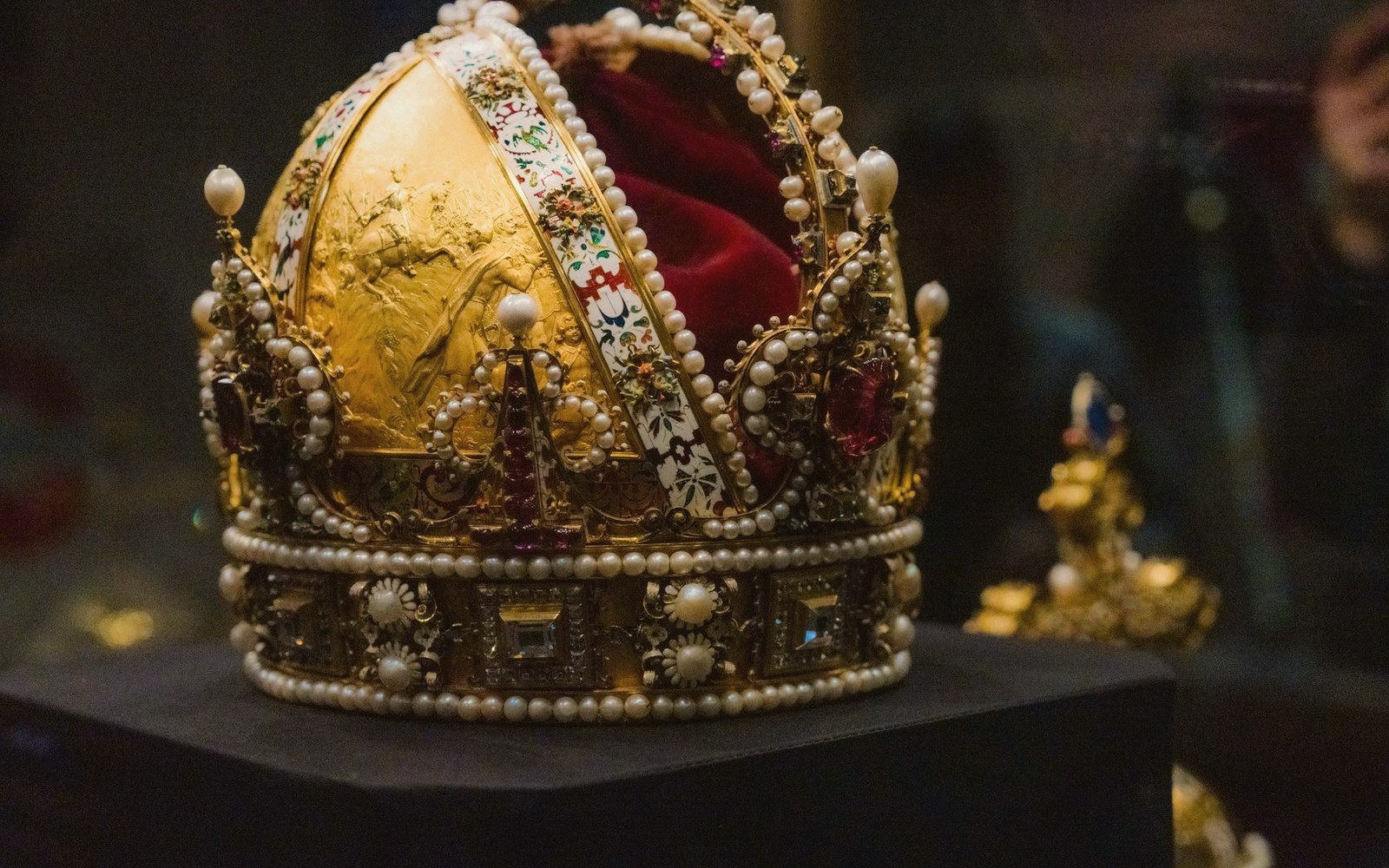
The most important object in the collection is not the largest or the most encrusted. The Imperial Crown of the Holy Roman Empire — made almost certainly in the late tenth century, probably for Otto I or one of his immediate successors — is a relatively modest object in size. Eight hinged gold plates, enamel panels depicting Old Testament kings, a jewelled arch added later, a cross at the front. What it says, however, is enormous.
The enamel panels show David, Solomon, and the prophet Isaiah alongside the Pantocrator — Christ in majesty. The message is structural: the emperor wearing this crown stands in a line that runs from Old Testament kingship through Christ himself. His rule is not analogous to divine authority; it participates in it. Every coronation in which this crown was used restaged that claim from the ground up.
The crown spent most of its history in Nuremberg before the French revolutionary wars forced its removal in 1796 and its eventual transfer to Vienna, where the Habsburgs kept it. The Nazis carried it back to Nuremberg in 1938, but it was returned to Vienna after the Second World War and has stayed there since. The fact that Vienna holds these objects, rather than some German national collection, is itself a piece of late imperial politics — and the Schatzkammer makes no great effort to explain this, which is worth pausing on.
The Holy Lance and the Problem of Relics
The Holy Lance — the spear said to have pierced Christ's side at the Crucifixion — sits in a case that feels oddly domestic for what is, in theological terms, one of the most charged objects in Christendom. The lance's history is tangled: the iron blade is genuinely ancient, probably Carolingian in its present form, with an inserted nail that medieval tradition held to be one of the nails of the Cross.
Whether the lance is what it was claimed to be matters less, historically, than the fact that emperors believed it was, or behaved as though they did. Carrying the Holy Lance in battle — which Carolingian and Ottonian rulers did — was not superstition but statecraft. The object materialised divine protection into something a soldier could see and a general could hold. Constantine's mother Helena was said to have found the True Cross; his successors needed their own talismans.
The Habsburgs' private relic collection, displayed separately within the Schatzkammer, shows how this thinking persisted well into the early modern period. A tooth of John the Baptist, fragments attributed to the Passion, pieces of the manger — the accumulation reads today as credulity, but it functioned as insurance. The more sacred objects a dynasty held, the more of heaven's attention it could plausibly claim.
Legitimacy as Material Culture
The secular regalia sit alongside the sacred objects with less fanfare, but they complete the argument. The orb, the sceptre, the ceremonial robes used at Habsburg coronations: these are the theatrical apparatus of a performance that had to be convincing in two directions simultaneously — upward, to God, and outward, to the watching courts of Europe. A coronation was a treaty with the divine, witnessed by rivals who needed to believe in its terms.
What the Kunsthistorisches Museum does with painting and sculpture — demonstrate the civilisational ambitions of Habsburg patronage — the Schatzkammer does with objects that predate the Habsburgs entirely. The genius of the collection is acquisitive: inheriting, capturing, or simply keeping the regalia of predecessor rulers meant absorbing their legitimacy. The Habsburgs didn't just collect relics; they collected the authority those relics encoded.
Walking the Schatzkammer slowly, in this frame, is genuinely different from moving through it as a parade of valuable things. The objects are old, many of them very beautiful, and all of them heavy with a weight that isn't gold. They were made or gathered to answer a question that no dynasty could afford to leave unanswered: by what right do you rule? The rooms hold a thousand years of replies.