What Stayed and What Was Stolen
The machinery of dispossession had several speeds
When German troops entered Vienna in March 1938, the looting of Jewish cultural property did not begin as chaos — it began as administration. The Anschluss triggered a cascade of bureaucratic mechanisms, each designed to separate Jewish Viennese from their possessions with the appearance of legal procedure. For collections, this meant forms, valuations, forced sales at ruinous prices, and export permits that functioned as extraction licences. The result was the largest single transfer of art out of Vienna since Napoleon.
The mechanisms were distinct and worth distinguishing. Outright seizure — the Gestapo arriving and removing works without payment — was one route, used especially against collectors who had already fled or been arrested. But a larger proportion of losses happened through what the regime called Zwangsverkäufe: compulsory sales. Owners under impossible financial and physical pressure sold collections to dealers, auction houses or institutions at fractions of real value, then watched the proceeds disappear into blocked accounts they could not access. A further mechanism was the export permit system: Jews emigrating were required to submit their remaining possessions for assessment, and the authorities routinely retained whatever they considered culturally significant as a condition of allowing departure. You could leave Vienna, but your Klimt stayed.
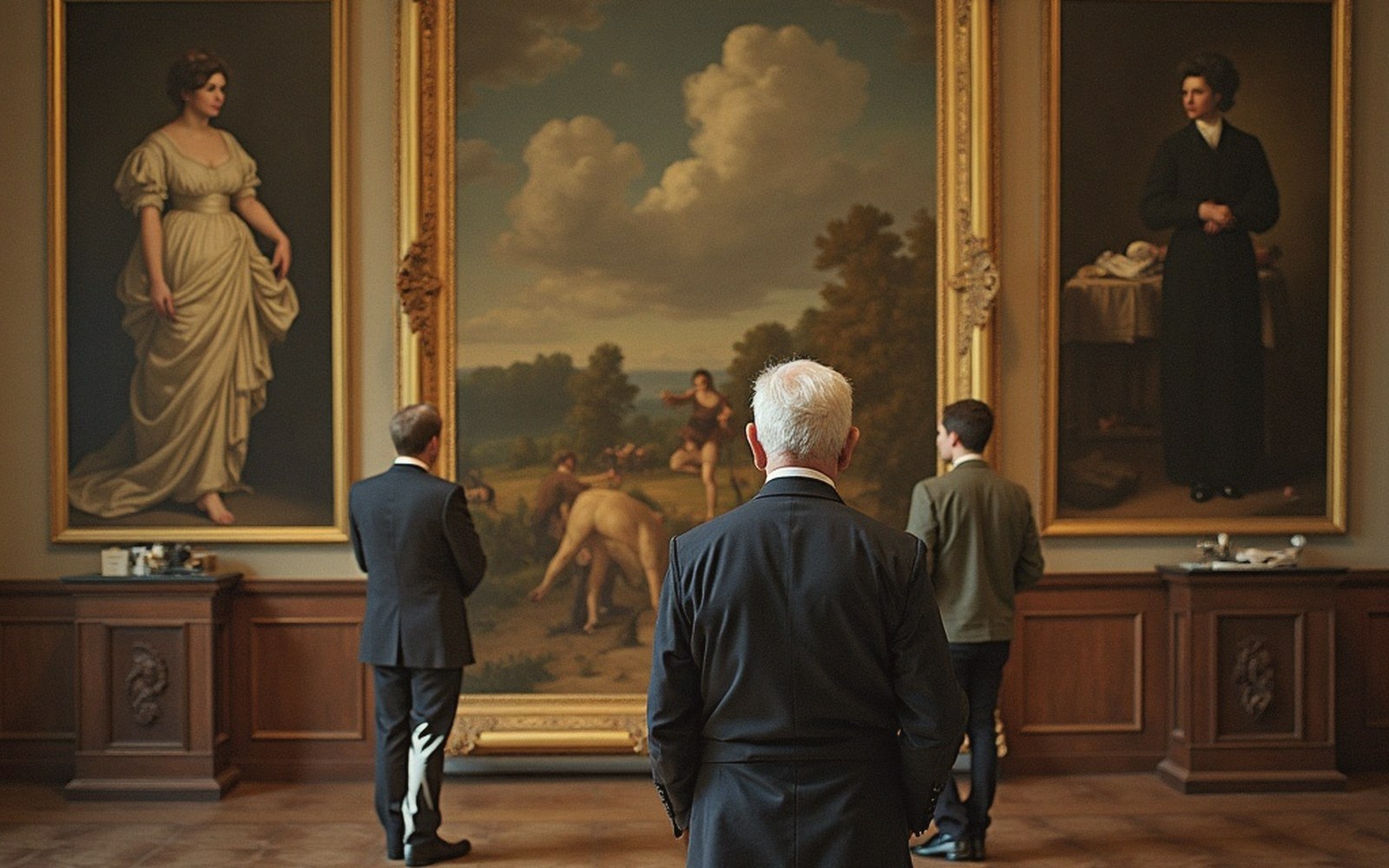
The institutions that benefited were not exclusively Nazi ones. The Kunsthistorisches Museum, the Albertina, the Österreichische Galerie — what is now the Belvedere — and the city's auction houses all acquired works through channels that were either directly coercive or structurally tainted by the surrounding coercion. Some acquisitions were made by officials who understood precisely what they were doing. Others were made by institutions following administrative routine. The distinction matters morally but less than one might expect in practice: the works left their owners under duress either way.
The postwar decades: a second failure
Liberation in 1945 did not reverse what had happened. Austria's postwar political identity rested on the claim that the country had been the first victim of National Socialism rather than a participant in it — a self-understanding that had catastrophic consequences for restitution. Restoring looted property requires first acknowledging that looting occurred, and that acknowledgment was structurally uncomfortable for a state that had positioned itself as a victim.
The Allied restitution laws of the late 1940s returned some property, but with severe limitations of time and evidence. Owners who had fled to other continents could not always navigate Austrian bureaucratic processes from abroad. Claims required documentation that had often been destroyed or was held by the very institutions being claimed against. The burden of proof sat with survivors and heirs rather than with the institutions holding the works. By the early 1950s, the formal restitution window had largely closed, and collections that had entered Austrian public ownership through forced sales or confiscation remained there — now legitimised by a further decade of undisturbed possession.
There was also a legal trap embedded in the postwar system. Austria's Monument Protection Act, which prohibited the export of culturally significant works, was applied against heirs who had retrieved their own property: you recovered your painting, then found you could not take it out of the country. In documented cases, families signed away restituted works to public collections in exchange for export permits for other pieces. The state, in other words, used heritage law as a secondary mechanism of retention after the primary mechanisms of 1938 had been partially unwound.
What changed, and what it cost
The Wally affair, American congressional pressure and, crucially, research by Austrian scholars through the 1990s forced a reckoning that the postwar decades had avoided. Austria's 1998 Art Restitution Law required federal museums to audit their holdings for works acquired through Nazi-era coercion, and to submit findings to an independent advisory board. For the first time, the burden shifted: institutions had to demonstrate clean provenance rather than claimants having to prove taint.
The consequences were substantial. Major works left the Belvedere, the Albertina and other collections. The Klimt restitution case in 2006, in which five paintings including the Portrait of Adele Bloch-Bauer I were returned to a niece of the original owners after a decade of legal argument, became internationally known. But most of the cases that followed were quieter — a drawing here, a piece of applied art there — and many collections still carry works whose histories between 1938 and 1945 cannot be cleanly accounted for.
When you stand before a work in a Viennese collection and read the provenance note on its label, what you are often reading is the compressed history of this failure and its partial correction. The gaps are not always accidents of lost records. Some of them are the shape that deliberate forgetting leaves behind.